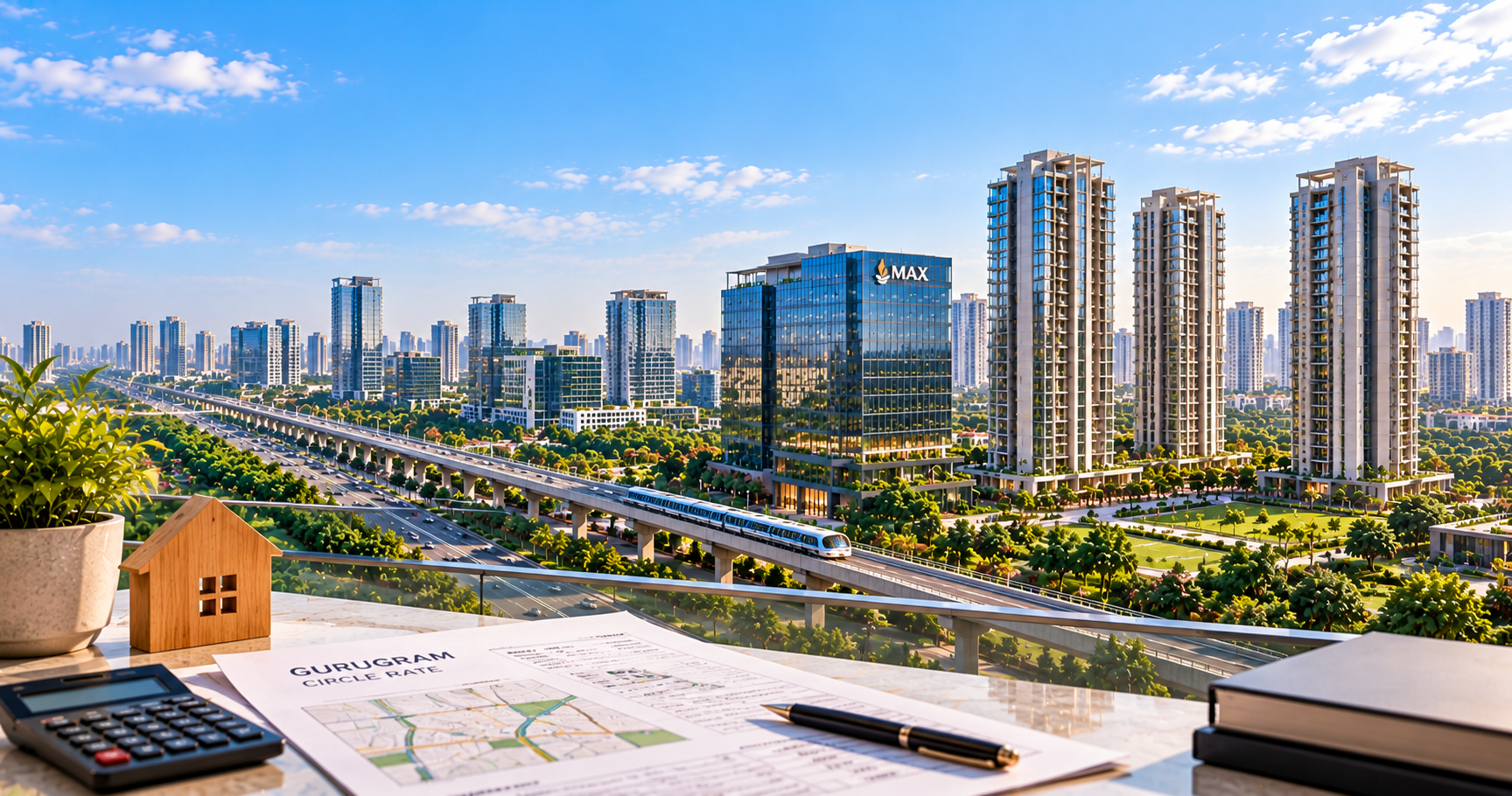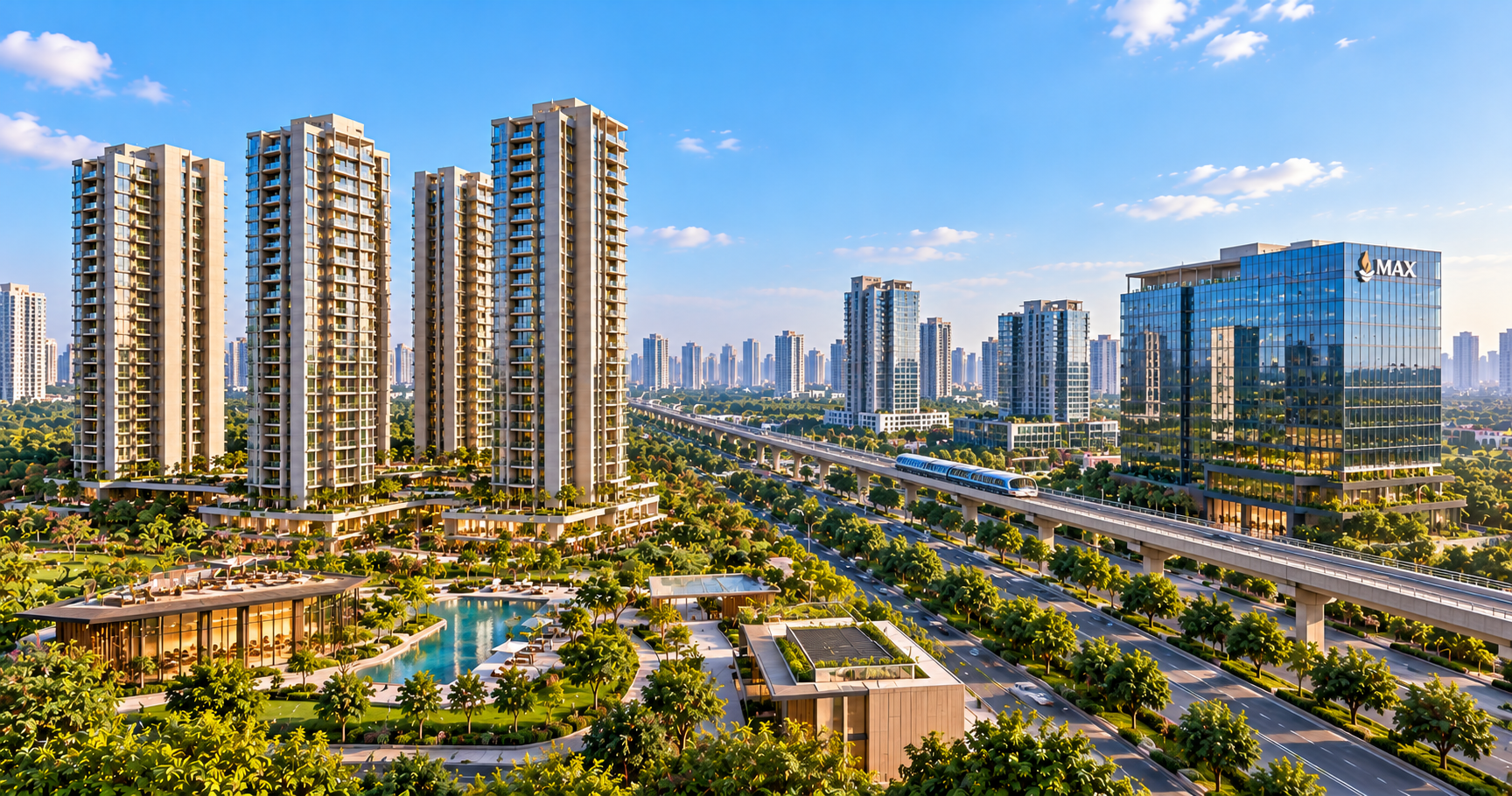

Brochures in Noida usually lead with tower height, clubhouse size and the number of amenities. The number that shapes daily life more than any of these is rarely printed: how many homes share each acre of land.
That figure decides how long the lift wait is at 9 am, how crowded the pool gets on a Sunday, and whether the "central green" is a lawn or a strip between parking ramps. For anyone comparing low-density luxury projects in NCR, it is also the easiest figure to check yourself, once you know where to look.
What Density Means in a Housing Project
Density is the number of homes divided by the land area, usually written as units per acre. A project with 500 homes on 10 acres runs at 50 units per acre. The same land with 270 homes runs at 27.
On paper the gap looks small. On the ground it nearly doubles the cars, deliveries, children in the play area and people in the gym at peak hours.
Density is not the same as FAR (floor area ratio). FAR caps the total built-up area a plot allows. Two projects with identical FAR can feel very different, because one builds fewer, larger homes while the other splits the same area into more, smaller units.
Why It Matters More in the Luxury Segment
At higher budgets, buyers are paying for space, inside the home and around it. A 4 BHK in a crowded tower still means shared lifts, busy parking aisles and a lawn everyone uses at once. In practice, low density is often what separates a premium address from an expensive one.
How to Work Out Density Yourself
You don't need anyone's word for it. Most of what you need is public.
- Total units. The project's RERA registration lists each phase and its units. For Noida and Greater Noida, search the UP RERA portal by project name or registration number. Add up all phases.
- Land area. Also in the RERA filing, in acres or square metres. Divide square metres by 4,047 to get acres.
- Units per acre. Divide the first number by the second.
- Open space share. Ask for the approved site plan. Check how much land is free of buildings, roads and ramps, and whether podium gardens or roof decks are being counted.
- Homes per floor and lifts per tower. Two to four homes per floor with dedicated lifts feels very different from eight homes sharing one lobby.
Our guide on what RERA covers and how to read a registration walks through the portal step by step.
Sector 128 as a Test Case
Sector 128 on the Noida Expressway is a useful place to test this, because one recent project there has published its numbers. Estate 128 by Max Estates is stated at about 27 homes per acre, with over 80% of the land kept as open space and wraparound decks on the residences. Its two phases are registered as UPRERAPRJ446459 and UPRERAPRJ294911, so the figures can be checked against the filings rather than taken from a brochure.
One caveat applies. The project is still under construction, and renders show landscape that does not exist yet. The developer's tower-wise construction updates are a better guide to timelines than any launch material. The Estate 128 project page lists the current details.
Run the same five steps on any other Sector 128 or Sector 150 project on your list. The point is not one project. It is having a number you can compare across all of them.
What Living in a Low-Density Project Changes Day to Day
People who have lived in both kinds of projects tend to mention the same things.
- Noise. More distance between towers means less sound bouncing between facades. Acoustic comfort is one of the least-checked parts of a home; a developer explainer on acoustic design in modern homes covers why.
- Daylight on lower floors. Wider tower spacing lets light reach the 3rd floor, not just the 23rd. In an NCR winter, with haze already cutting sunlight, this matters.
- Amenities that stay usable. A pool sized for 300 families is pleasant. The same pool shared by 900 is not.
- Resale questions. Luxury buyers at resale increasingly ask about density, because they are comparing the same things you are.
The Trade-offs Worth Knowing
Low density is not free. Land cost is spread over fewer homes, so the price per square foot is usually higher. Maintenance charges can also run higher, since fewer households share the upkeep of the same landscape.
And density alone doesn't make a good project. Location, build quality and the developer's delivery record carry more weight. If you are still deciding on the sector itself, start with our roundup of the best sectors in Noida to live in, then use density to choose between projects inside it.
Checklist Before You Book
- Units per acre, calculated from RERA filings, not the brochure
- Open space percentage, and exactly what it includes
- Homes per floor and lifts per tower
- Distance between towers on the approved site plan
- Construction stage, checked against the latest tower-wise update
- Maintenance charge per sq ft, in writing
Frequently Asked Questions
What counts as low density for a housing project in Noida?
There is no official cut-off. In the luxury segment, projects under roughly 30 to 35 homes per acre are generally seen as low density. Many mid-segment projects run well above 60.
Where can I check the number of homes in a project?
In the project's RERA registration. On the UP RERA portal, search by project name or registration number and check each phase separately.
Does low density mean higher maintenance charges?
Often, yes. Landscape and common-area costs are split among fewer households, so the per sq ft charge can be higher. Get the estimate in writing before booking.
Is open space the same as green space?
No. Open space can include driveways, plazas and paved courts. Ask what share of the land is under actual planting.
Should density matter more than location?
Usually not. Location and the developer's delivery record come first. Density works best as a filter between two otherwise similar options.