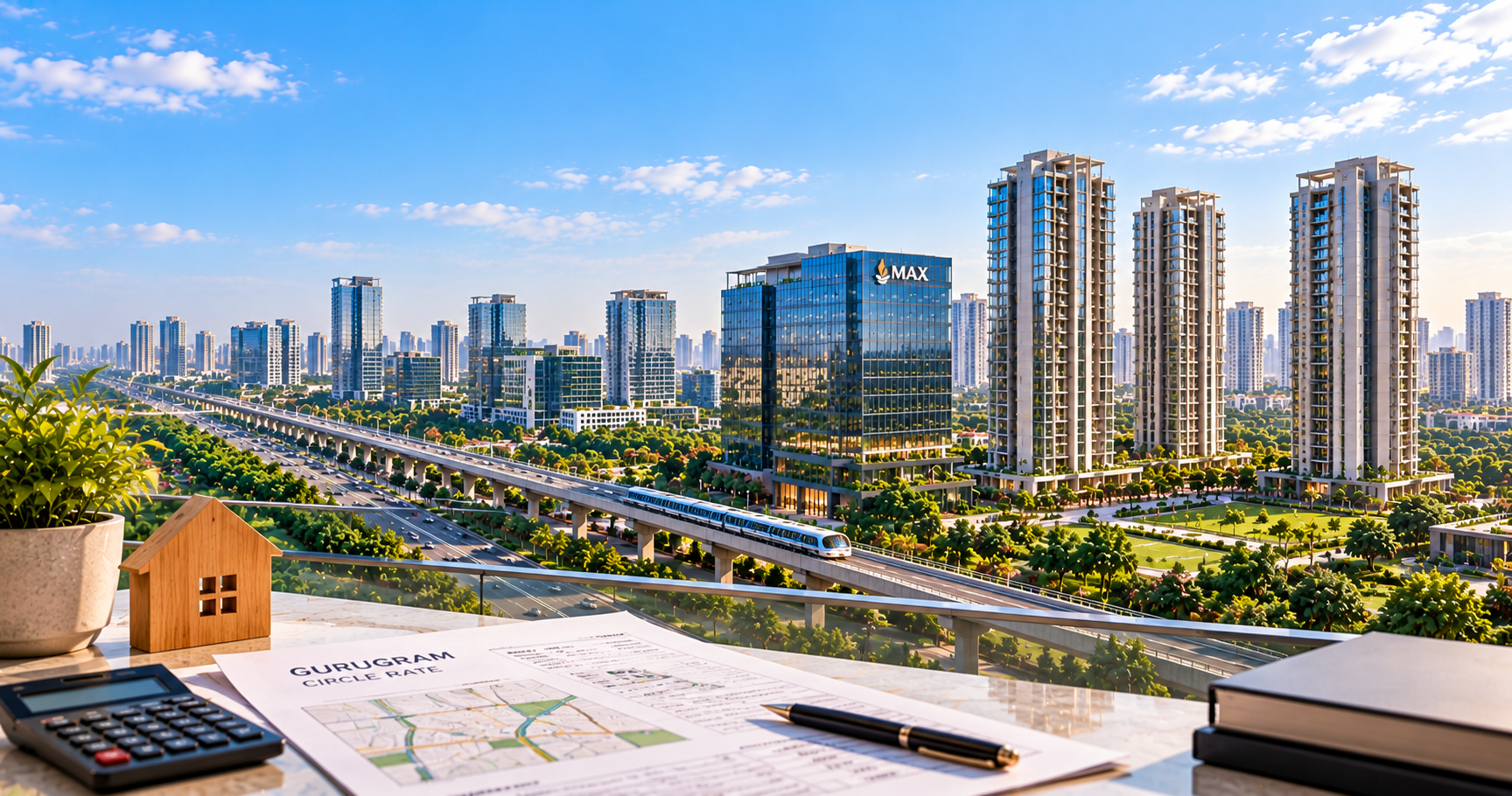

ESG shows up in almost every commercial lease pitch in Delhi NCR now, usually as a slide with a LEED or IGBC logo on it. Fewer buyers and investors actually know what's being measured underneath that logo, or why a global tenant's procurement team might reject an otherwise perfect building over it. This guide breaks down what ESG actually means in a real estate context, why it's started mattering for pricing and leasing in India specifically, and what to check before you assume a project's ESG claims hold up.
ESG, Broken Down for Property, Not Just Companies
ESG stands for Environmental, Social, and Governance, three categories originally built for evaluating listed companies, now applied directly to individual buildings and developers. In a real estate context, each pillar maps to something concrete rather than abstract.
| Pillar | What It Actually Covers in a Building |
|---|---|
| Environmental | Energy consumption, water use and recycling, waste management, embodied carbon in construction materials, and whether the site preserves or destroys existing green cover |
| Social | Tenant and worker wellbeing, construction labour safety records, accessibility design, and how a project engages the surrounding community rather than walling itself off from it |
| Governance | How transparently a developer discloses project data, RERA compliance history, financial reporting quality, and whether sustainability claims are third-party verified or just stated in a brochure |
Why This Started Mattering for Indian Real Estate Specifically
Three separate forces pushed ESG from a nice-to-have into something that actually moves deals in India, and none of them are marketing-driven.
SEBI's BRSR Mandate
The Securities and Exchange Board of India requires the top 1,000 listed companies by market capitalization to file a Business Responsibility and Sustainability Report, covering energy use, emissions, and governance data. Every listed real estate developer in NCR, DLF, Godrej Properties, Signature Global, Max Estates, and others, falls inside that requirement. In 2025, SEBI introduced a more granular "BRSR Core" layer demanding verifiable, standardised data rather than self-reported summaries, which means a listed developer's ESG numbers are now something you can actually cross-check rather than take on faith.
Global Capability Centres Are Setting the Leasing Bar
Global Capability Centres, the India-based offices of multinational companies, have become one of the largest tenant categories for Grade A commercial space in NCR, and most of them lease against an ESG compliance checklist set by their global headquarters, not their India country team. Carbon disclosure, indoor air quality data, and verified certification, not just a certification logo, are now standard conditions in these leasing conversations. A building without documented data behind its green claims increasingly gets filtered out before it reaches a shortlist.
Institutional Capital Wants a GRESB Score
GRESB, the Global Real Estate Sustainability Benchmark, is what large institutional investors and REITs use to compare ESG performance across real estate portfolios internationally. Indian developers courting the same institutional capital that funds REITs abroad, pension funds, sovereign wealth vehicles, global insurers, increasingly need to report against this benchmark to stay relevant to that capital pool, not just to Indian retail buyers.
Certifications Are the Evidence, Not the Point
India has three certification systems doing most of the work here, and they're not interchangeable.
IGBC, run by the Confederation of Indian Industry, is India's most widely adopted rating system and has targeted 10 billion sq ft of certified space nationally. GRIHA, the government-backed alternative, has been expanding specifically into affordable housing and retrofits for existing buildings rather than only new construction. LEED, the US Green Building Council's system, remains the reference point for multinational tenants and global investors who want a certification they already recognise from other markets.
None of these certifications alone constitutes ESG compliance. A green building certification documents environmental design, largely the "E" in ESG, but says nothing about labour practices during construction, community engagement, or how transparently a developer reports its numbers. Treat a LEED or IGBC plaque as evidence of one input, not a substitute for checking the rest.
Who's Actually Ahead on This in India Right Now
Most of the "ESG leadership" language in Indian real estate is aspirational. A few names have the disclosed numbers to back it up.
Embassy Office Parks REIT has been ranked number one in India for public disclosures by GRESB and holds a 5-star GRESB rating for multiple consecutive years, with its development portfolio scoring 99% in the most recent assessment cited by the REIT. It was also recognised as the world's largest USGBC LEED Platinum-certified office portfolio, and in 2023 became the first Indian REIT included in the Dow Jones Sustainability Indices. The REIT has additionally committed to net zero carbon operations by 2040 across its own Scope 1 and 2 emissions.
Brookfield India REIT has held a 5-star GRESB rating for three consecutive years and was named GRESB's Global Sector Leader for Sustainable Mixed-Use Development, scoring 100 out of 100 on its development portfolio. In December 2025, it raised ₹2,000 crore through sustainability-linked bonds anchored by the International Finance Corporation, with proceeds tied to renewable energy and water stewardship targets, on top of roughly 1.41 MWp of rooftop solar capacity already installed across its buildings.
On the developer side rather than the REIT side, Max Estates carries LEED Platinum certification at Max Towers and an IGBC Platinum pre-certification at Max Square, though as a newer listed entrant it doesn't yet have the multi-year GRESB track record that Embassy and Brookfield have built. Worth noting since this site also works with Max Estates on marketing: that gap is real, not something to gloss over.
What This Means for Your Return, Not Just Your Conscience
ESG credentials are increasingly showing up in hard numbers rather than staying a values-based argument.
Rental and Occupancy Premiums
Certified Grade A commercial buildings in NCR are increasingly the market standard for large corporate and GCC leases, which means an uncertified building competes on price alone against a shrinking pool of tenants willing to accept it. That shows up as a real difference in achievable rent and vacancy risk between a certified and uncertified building in the same micro-market, not just in marketing language.
Financing and Exit Liquidity
India's National Green Taxonomy, still under development, is expected to formally define which assets qualify as "green" for financing purposes, which will likely make certified projects eligible for cheaper green-bond-linked capital than uncertified ones. On the exit side, an asset with clean BRSR-aligned governance data and third-party certification is simpler for an institutional buyer's due diligence team to underwrite than one without it, which can matter directly at resale.
Governance Data Protects You as a Buyer, Not Just the Developer
The governance pillar is the one individual buyers tend to skip past, but it's arguably the most directly useful one. A developer with a clean, verifiable RERA compliance history and transparent financial disclosure, the kind BRSR now forces on listed players, is a lower-risk counterparty regardless of how green their buildings are.
How to Check Before You Trust an ESG Claim
A certification logo on a brochure is a starting point for a question, not an answer by itself.
Ask whether the certification is "pre-certified" or fully certified. Pre-certification is issued based on design intent before construction completes, and a project can carry that label for years without ever converting to a final, as-built certification. Ask for the certifying body's registration number and verify it directly on IGBC's, GRIHA's, or USGBC's own project directory rather than trusting a sales team's description. And for a listed developer, pull their actual BRSR filing from the stock exchange rather than relying on a summarised version in a pitch deck, since the underlying filing is public and free to access.
Frequently Asked Questions
Is ESG certification legally required for real estate projects in India?
Green building certification itself is voluntary. What's mandatory is BRSR disclosure for the top 1,000 listed companies by market cap, which includes most major listed developers, covering environmental and governance data at the company level rather than certifying individual buildings.
Does a green-certified building actually cost less to run?
Typically yes on operating costs, since these buildings are designed around lower energy and water consumption. Whether that saving offsets any premium paid upfront depends on the specific project, the certification level, and how long you hold the asset.
What's the difference between a pre-certified and fully certified green building?
Pre-certification is awarded based on design plans before construction is complete, essentially a commitment to a target. Full certification requires an as-built audit confirming the completed building actually meets the standard. A project can market itself as pre-certified for years without ever completing that second step.
Why do multinational tenants care about a landlord's ESG data specifically?
Many multinational tenants, particularly Global Capability Centres, report their own carbon and sustainability data up to a global headquarters, and their leased office space is part of that reporting chain. A landlord who can't provide verified building-level data makes the tenant's own compliance harder, which increasingly rules a building out of consideration before commercial terms are even discussed.