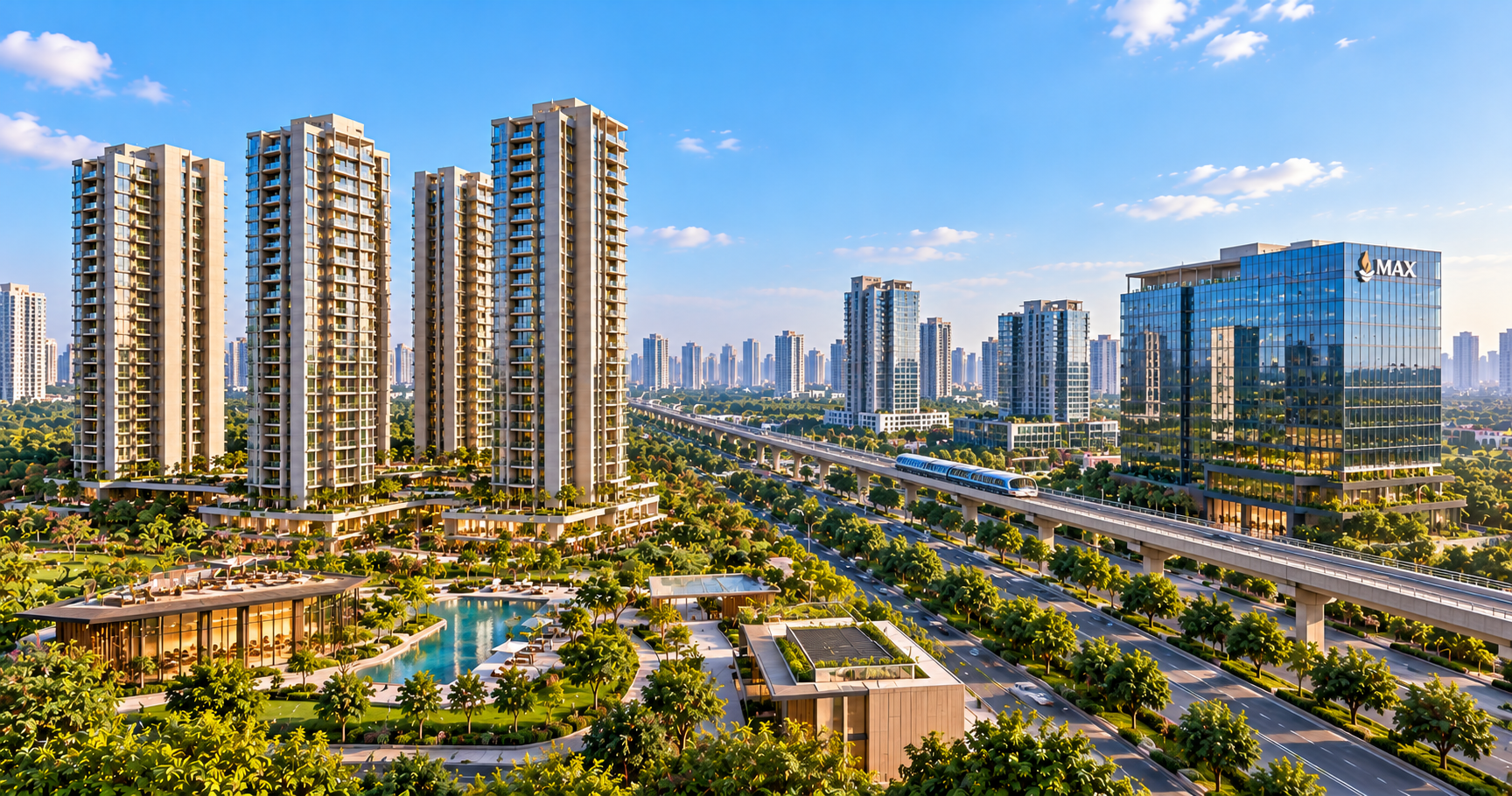

Delhi is running out of room in the way that matters most for a landlocked city: horizontally. The population is projected to climb from roughly 2.4 crore today to 3.2 crore by 2047, and every direction the city could once expand into is already built up or hemmed in by neighbouring states. The Delhi Development Authority's response is the Master Plan for Delhi 2047, a document that reorganises how the capital grows for the next two decades, and it has implications well beyond Delhi's own borders for anyone tracking the wider NCR market.
This piece walks through what the plan actually proposes, sector by sector, and what it plausibly means if you're buying, holding, or watching property anywhere in the Delhi NCR corridor rather than just within Delhi's municipal limits.
The Headline Numbers
The plan targets nearly 40 lakh new affordable homes, built through a combination of redeveloping existing areas and pushing low-cost residential construction inside Transit-Oriented Development zones and High Density Corridors. Two FAR incentives sit underneath that number: a 15% bonus for workers' housing on industrial plots of 5,000 sq m or larger, and a 50% bonus specifically for affordable rental housing. Separately, the plan regularises 150 sq km of Low-Density Areas across Delhi's peripheral villages, including 23 formally notified Low-Density Residential Area villages.
Land Pooling Is the Structural Bet
The single biggest lever in this plan is land pooling, roughly 200 sq km of planned urban development expected to yield around 12 lakh new homes, supported by a 600-km road network built out alongside it. The mechanism works through planning schemes covering a minimum of 20 hectares, where landowners pool their parcels together for coordinated development rather than piecemeal, plot-by-plot construction.
Sector 8B in Zone P-II, covering Village Gadi Khasro and Ibrahimpur, is the first sector to get formal notification and is described as ready for implementation. That makes it the one concrete, checkable data point in the entire land pooling programme right now, everything else is still a proposal on paper until its own sector notification comes through.
What Happens to Unauthorised Colonies
1,511 unauthorised colonies get a path to regularisation on an "as is where is" basis, with no requirement for layout plans, a deliberate simplification meant to speed up a process that has historically dragged on for years. The plan estimates this affects around 45 lakh residents, giving them clearer ownership security over homes they've often occupied for decades without full legal title.
Commercial Redevelopment Gets Easier
Commercial centres sitting on plots of 1,000 sq m or more become eligible for redevelopment through incentivised FAR, and a previous four-hectare area-level requirement for plot-based redevelopment is being waived, which should unlock smaller, standalone commercial plots that couldn't previously qualify. Mixed-use development is permitted along any road with a Right of Way of 30 metres or wider, and buildings can now run commercial activity on the ground floor and the first floor above a stilt.
On the industrial side, the plan allows big-box retail, e-commerce facilities, and warehousing inside industrial areas, alongside co-working spaces and data centres, both fairly new categories for Delhi's industrial land use rules. The number of legally defined "use premises," the classification system that determines what can legally operate on a given plot, is being cut from 133 categories down to 45, which in practice means far less friction switching a property's use without a fresh approval cycle.
Dwarka's New Role Should Matter to the Whole Corridor
The plan designates Dwarka as Delhi's International Gateway, with world-class infrastructure and future-ready industry positioned around it. That's worth pausing on if you're following the NCR market broadly rather than Delhi specifically, since Dwarka sits directly at one end of the Dwarka Expressway corridor, the same stretch we covered project by project recently, where developers like Signature Global, Godrej, and Max Estates already have significant under-construction inventory. A formal Gateway designation on the Delhi side of that corridor is the kind of policy signal that tends to show up in land values on the Gurugram side within a few years, not immediately.
Narela gets a parallel push as a planned education hub, with around 138 hectares reserved for public and private university development, a smaller-scale but similar logic: designate a specific use, then let land values and construction follow it.
Transport Gets Built Around Multi-Modal Hubs
Rather than treating each transit mode separately, the plan calls for multi-modal hubs that connect Metro, the Regional Rapid Transit System, buses, intermediate public transport, and dedicated walking and cycling infrastructure at the same physical location. Three Urban Extension Roads, UER-I, UER-II, and UER-III, are meant to strengthen both intra-city movement and connections to neighbouring states, and a Unified Parking Planning Framework is proposed to bring some consistency to what has historically been an ad hoc, ward-by-ward approach to parking regulation.
The Yamuna Floodplain Gets Real Protection, on Paper
Roughly 1,700 hectares of Yamuna floodplain are earmarked for protection and ecological restoration through 13 named restoration projects, alongside expanded sewage treatment capacity aimed at improving the river's water quality directly. A 52-km cycle track is planned along the floodplain itself. Separately, the plan pushes energy-efficient building codes, rooftop solar, rainwater harvesting, water recycling, and waste-to-resource processing as standard rather than optional, backed by a "Green Connect Network" meant to link recreational green spaces across the city and GIS-based digital platforms for planning and enforcement.
Heritage Conservation Comes With a New Financial Tool
About 1,500 heritage assets are covered under new Cultural Resource Management Plans, with adaptive reuse explicitly permitted, meaning a heritage building could legally become a hotel, museum, office, or library while its historic character stays protected. For the first time, the plan introduces a Heritage Incentive of 50 Transferable Development Rights, a mechanism that essentially lets a heritage property owner monetise unused development rights by transferring them elsewhere, rather than being stuck with a building they can't modify and can't profitably use. Kartavya Path's redevelopment into a full public and cultural space, and a planned Yuge Yugeen National Museum, are the two flagship projects attached to this section.
What This Actually Means If You're Buying in NCR
The honest answer is that this plan won't move every part of the market the same way, and treating it as a uniform tailwind for Delhi NCR property values would be a mistake.
Where Returns Could Come Faster
High-density TOD corridors, land near the new metro and RRTS connection points, and sectors already flagged for commercial redevelopment are the parts of this plan closest to actual construction. These are the areas where infrastructure spending and zoning changes tend to translate into price movement within a shorter window, because the groundwork is already partly in motion rather than waiting on land assembly.
Where Patience Is the Right Strategy
Land-pooling belts in outer Delhi are a different bet entirely. Until trunk infrastructure, water, sewage, road connectivity, is actually operational rather than planned, these zones function as long-horizon, slow-burn investments. Sector 8B is the one exception with a formal notification behind it; everything else in the land-pooling programme is still one step removed from that.
What to Verify Before Acting on Any of This
A master plan provision and an active, on-the-ground development are not the same thing. Before treating any part of this plan as an investment thesis, check the DDA's official sector notifications directly rather than relying on a broker's interpretation of "upcoming" zones, evaluate whether local civic utilities, water supply and sewage in particular, can actually support the density being proposed, and confirm RERA registration status on any specific project a sales team points you toward as benefiting from this plan.
Frequently Asked Questions
Will the Master Plan for Delhi 2047 push property prices up everywhere?
No, not uniformly. TOD corridors and areas near confirmed metro or RRTS connections are more likely to see nearer-term price movement, while land-pooling zones in outer Delhi depend on infrastructure that hasn't been built yet and could take years longer to show the same effect.
Does this plan actually increase housing supply, or is it mostly policy language?
The supply-side numbers are specific: close to 40 lakh new homes are targeted through TOD zones, High Density Corridors, and the land-pooling programme. Sector 8B already has a formal notification behind it, which makes it the clearest near-term supply signal in the plan right now.
Which parts of Delhi NCR should investors actually watch because of this plan?
Dwarka, given its new designation as Delhi's International Gateway, is the one with the clearest potential spillover into the wider NCR market, particularly along the Dwarka Expressway corridor into Gurugram. Narela's education-hub designation and the notified Sector 8B land-pooling zone are the other two concrete markers worth tracking directly against DDA updates rather than secondary reporting.