
Quick answer: There is no truly "low AQI" neighbourhood in Delhi NCR in winter, because the smog is regional. The homes that cope best combine three things: a low-density site with large planted open areas and a vehicle-free ground level, well-sealed windows with filtered fresh air, and an independent green certification such as IGBC, LEED or GRIHA. In Noida, Max Estates' Estate 128 and Estate 105 are IGBC Platinum pre-certified residential projects. In Gurugram, Estate 360 on the Dwarka Expressway is planned around 700 trees on 11.8 acres.
Every November, "Delhi AQI" climbs back into the top real estate searches in India. For homebuyers, the useful question is not what today's AQI is, but which homes make the winter easier to live through. This guide explains what green cover and building design can and cannot do for air at home, which certifications are worth checking, and which NCR projects are planned around open space, wellness and cleaner indoor air.
For city-level data on how Delhi, Noida, Gurugram and Ghaziabad compare across the year, see our guide to AQI in Delhi NCR and its impact on real estate. This post is about choosing a project.
Key takeaways
- Green cover cuts local dust, noise and heat. It does not filter regional winter smog.
- Indoor air depends most on window sealing, filtered fresh air and maintenance.
- IGBC, LEED and GRIHA certifications are independent checks. Ask whether a rating is pre-certification (design stage) or final.
- Low-density projects with vehicle-free grounds, walking tracks and setbacks from main roads are the most practical "low AQI" choice.
- Check the nearest CPCB monitoring station for a few weeks in November and December before you buy.
What makes a home "low AQI" in Delhi NCR?
Winter smog in NCR is a regional problem. No landscaped estate can keep it out of the neighbourhood. A well-planned project can reduce the local load and give you control over the air inside your home.
| Feature | What it realistically helps with | What it does not do |
|---|---|---|
| Large open, planted areas | Less local dust, cooler surfaces, a buffer from road noise and fumes | Filter regional winter smog |
| Vehicle-free ground level | Fewer exhaust fumes on walking tracks and play areas | Change the air on the main road outside |
| Low density (fewer homes per acre) | More light, cross-ventilation and quiet | Clean the air on its own |
| Sealed windows and filtered fresh-air systems | Cleaner indoor air when outdoor AQI is poor | Work if poorly maintained or switched off |
| Green certification (IGBC, LEED, GRIHA) | An independent check on ventilation, materials, water and energy | Guarantees a particular indoor AQI |
IGBC and LEED certified projects in Noida and Gurugram
Green certification is spreading fast in NCR. At the IGBC GreenTech Summit 2026, the council reported 2,475 registered projects across NCR, including 748 in Noida and Greater Noida and 651 in Gurugram. Registration is not certification, so always ask for the certificate and its level.
| Project | Location | Type | Certification (as stated by developer) |
|---|---|---|---|
| Estate 105 | Sector 105, Noida Expressway | Residential, 270 homes in 2 towers | IGBC Platinum pre-certified |
| Estate 128 | Sector 128, Noida Expressway | Residential | IGBC Platinum pre-certified |
| Max Towers | Sector 16B, Noida | Office | LEED Platinum; IGBC Platinum for Health and Well-Being |
| Max Square | Sector 129, Noida Expressway | Office | IGBC Platinum |
| Max House | Okhla, Delhi | Office | LEED Gold; IGBC Gold |
Developers in Noida have a reason to certify: Uttar Pradesh offers additional floor area ratio to projects with IGBC certification, according to IGBC. That makes certification more common, which is good for buyers, but it also means you should check the level and stage, not just the logo.
Wellness residential projects in Noida and Gurugram
"Wellness" is used loosely in property marketing. A project earns the label when you can see the planning in the site plan: open ground, walking tracks, low density, quiet zones and spaces for older residents. Examples worth comparing:
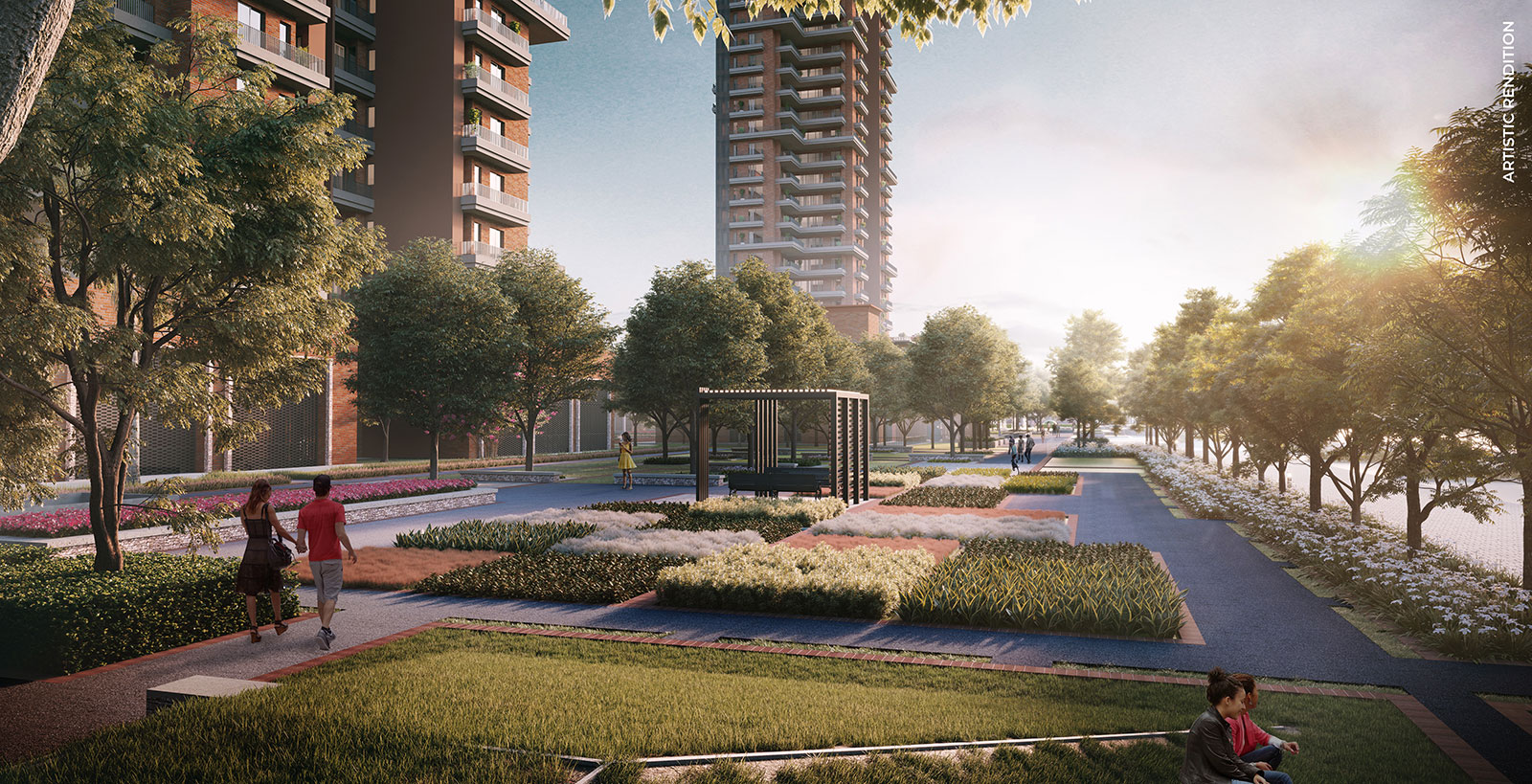
Estate 128, Noida Expressway (Max Estates)
Max Estates describes Estate 128 as its first LiveWell community in NCR, launched in 2023, with over 80% open space across about 10 acres and large decks on the homes. It also has dedicated senior well-being spaces managed by Antara Senior Living. The site is on the Noida Expressway, so its advantage is the open layout, not the distance from traffic. See our guide to residential projects in Sector 128 Noida.
Estate 105, Noida Expressway (Max Estates)
Launched in March 2026, Estate 105 is described by the developer as a "movement-first" residential community and is IGBC Platinum pre-certified. Ask for the final certificate at completion.
Estate 360, Dwarka Expressway, Gurugram (Max Estates)
Estate 360 in Sector 36A covers 11.8 acres, with 700 trees of 33 species planned across the estate, according to the developer's brochure. Max Estates calls it NCR's first intergenerational community, with two of its six residences set aside for senior living managed by Antara. The Dwarka Expressway is still a busy construction corridor, which matters for the next few winters. Its sister project, Estate 361, follows the same LiveWell approach.
Other options to compare
- M3M Antalya Hills, Sector 79, Gurugram: a low-rise development of about 33 acres near the Aravalli foothills, with possession of about 1,000 homes announced in July 2026.
- Noida Sector 150: a sector known for planned green areas and golf course frontage. Compare individual projects on open area and distance from the expressway.
Before you shortlist, compare at least two developers on the checklist below rather than relying on brochure words such as "lungs" or "forest".
Green cover makes the neighbourhood around your home better. Sealed windows, filtered fresh air and maintenance make the air inside it better. Ask about both.
Low-density, low-noise homes: what to look for
Buyers searching for homes away from city noise, homes with walking tracks or cross-ventilated apartments are usually looking for the same thing: a calm site. These are the planning features that deliver it.
- Homes per acre. Ask for the number of units and the site area, and divide. Lower is calmer.
- Tower placement. Towers set back from the expressway, with the clubhouse or landscaping between them and the road, are quieter and less dusty.
- Two-side ventilation. Homes with openings on two sides ventilate better on clear days. Corner units usually do best.
- Walking and cycling tracks at ground level, away from car ramps.
- Double glazing and acoustic seals on windows facing the main road.
Checklist: eight things to check in any project
- Open area as a share of the site. Ask how it is calculated. Ground-level planted area matters more than podium decks.
- Number of trees, and whether they are mature. Saplings take years to give shade or a buffer.
- Where the cars go. A fully underground car park keeps exhaust away from walking paths.
- Distance from the main road and from dust sources such as construction belts.
- Window and façade specification. Ask about double glazing and seals.
- Fresh-air systems. Ask what is installed, what is only a provision, and who maintains it.
- Certification. IGBC, LEED or GRIHA, the level, and whether it is pre-certified or final.
- Your micro-location. Check the nearest CPCB station on the SAMEER app over a few weeks.
Then check the basics that apply to every purchase. Our guides on RERA, comparing top builders in Delhi NCR and how to check an occupancy certificate cover these.
Frequently asked questions
Which are the low AQI homes in Delhi NCR?
No part of NCR has consistently clean winter air. The homes that cope best are in low-density projects with large planted areas, vehicle-free grounds, setbacks from main roads, sealed windows and filtered fresh air. Examples include Estate 128 and Estate 105 on the Noida Expressway and Estate 360 on the Dwarka Expressway.
Which projects in Noida are IGBC certified?
On the residential side, Max Estates states that Estate 105 and Estate 128 are IGBC Platinum pre-certified. Commercial examples include Max Square (IGBC Platinum) and Max Towers (IGBC Platinum for Health and Well-Being). IGBC reports 748 registered projects in Noida and Greater Noida, so ask any developer for its certificate and level.
Which projects in Noida are LEED certified?
Max Towers in Sector 16B is LEED Platinum certified. LEED is more common on offices than on homes in Noida, where IGBC is the usual rating for residential projects.
Which are the best wellness residential projects in Noida?
Look for projects whose site plan shows the wellness features: high open area, walking tracks, low density and senior-friendly spaces. Estate 128 (over 80% open space on about 10 acres) and Estate 105 (IGBC Platinum pre-certified) are two examples on the Noida Expressway.
Does living in a green project protect you from Delhi's pollution?
Not fully. Green cover reduces local dust and traffic fumes, but winter smog is regional. Indoor air depends more on sealed windows, filtration and ventilation.
What is the difference between IGBC pre-certification and certification?
Pre-certification is awarded on the design. Final certification comes after the building is complete and assessed. Ask the developer which one a project holds.
Are low-density projects quieter?
Usually, yes. Fewer homes per acre, towers set back from the road and vehicle-free grounds all reduce noise. Check the site plan and visit at peak traffic hours.
Is a low-rise home better for air quality than a high-rise?
Not automatically. Low-rise projects often have more open ground per home, but upper floors in high-rises can sit above some street-level dust. Ventilation and sealing matter more than height.
Project details are based on developers' published material and press reports as of November 2026, and can change. This article is for information only and is not medical or financial advice.